
I’ve been in a conversation with a friend about artificial intelligence. We’ve circled around it from different angles, not quite landing in the same place. At one point, he said, almost in frustration, that something about it made his “hackles stand up.” I understood that. I’ve felt some of that myself.
Part of what we were wrestling with had to do with thinkers like Ilia Delio and Pierre Teilhard de Chardin—the idea that AI might somehow belong within the unfolding story of evolution, even consciousness. For him, that felt like a line that shouldn’t be crossed. For me, it wasn’t so simple.
I find myself moving back and forth on this. Some days more hopeful, other days (much) more wary.
It’s tempting to say the real question is whether AI will save us or destroy us. That’s how the conversation usually unfolds with promise on one side, fear on the other. But I’m not sure that’s the best question.
There’s something deeper. Something more fundamental. It’s not just a matter of what AI will become, but what we have become—and are becoming.
AI did not arrive in a vacuum. It has emerged from within a particular kind of world. One already shaped by assumptions about what a human being is for. Long before algorithms learned to predict our behaviour, there were systems measuring our worth in productivity, efficiency, and consumption. Long before data was harvested, attention itself was being shaped, captured, and sold.
You can feel it in small ways, in how quickly we reach for a screen instead of a person, and in how easily attention gets splintered without us quite noticing.
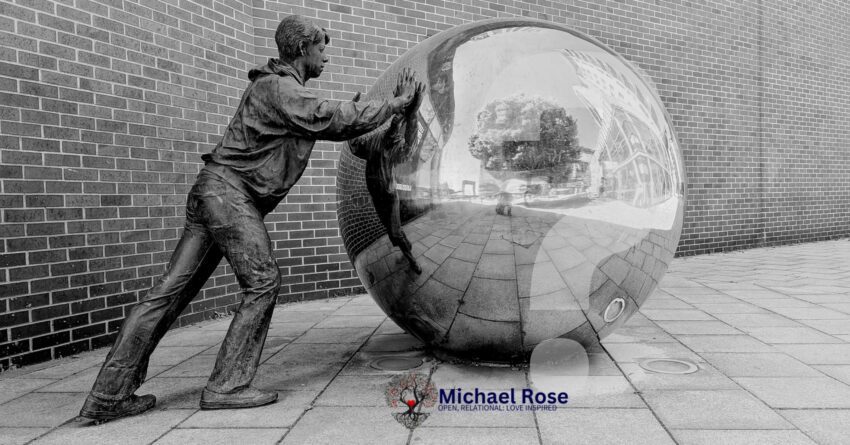
While AI may indeed be a line too far, it also serves as a mirror. And like most mirrors, it reflects what already is and sometimes more accurately than we’d like.
Some of our concern is about the technology itself, with its speed, reach, and power. But some of it runs deeper. A recognition that we may not have been honest with ourselves for a long time now.
If a human being is primarily a producer, AI will simply do that better.
If a human being is primarily a consumer, AI will refine and serve those desires more efficiently.
If a human being is data, AI is the natural extension of that logic.
But if a human being is something more—something fuller—then the questions begin to change.
We find ourselves asking not just what we can build, but what kind of life we are shaping around what we build. Not just what is possible, but what is good. Not just what works, but what is worth becoming.
Maybe then, the question gets more granular:
What is a human being for?
And what is it to be human?
Even these questions need to be held gently. Because “purpose” can become another way of reducing the human, turning life into a task to complete or a function to perform. And description alone can drift, if it never asks where our lives are actually heading.
So we hold both.
A human being is not only for something.
A human being is also something.
Not a function, but a presence.
Not merely aimed toward a goal, but already living within a reality— being formed by it, shaped by it, sometimes carried by it.
To be human is to be embodied, finite, relational, and particular. We experience, love, suffer, wonder, create, fail, and begin again.
There is a depth to being human that does not reduce neatly to outcome or efficiency. Even love is not simply a goal we achieve. It is something we fall into, resist, receive, and slowly grow into.
We are for love, yes.
But we are also of love.
And at times, simply in its presence—learning what that means.
Some days that feels close at hand. Other days, not so much.
The human story is not isolated. It is part of a much larger unfolding. As Pierre Teilhard de Chardin suggested, in the emergence of human self-awareness, the cosmos has, in some sense, become aware of itself.
Not because we stand above creation, but because we arise from within it.
Matter becomes life.
Life becomes consciousness.
Consciousness becomes self-awareness.
[More complex consciousness increases the capacity for more complex expressions of love.]
And through reflective consciousness, we begin to notice that we are noticing.
This is not a hierarchy with humanity at the top. It is a living field of wholes within wholes—interdependent, entangled, mutually shaping. Humanity is not the whole, but a whole within a larger whole. Distinct, influential, and deeply dependent.
We breathe what the trees release.
We eat what the earth provides.
We are sustained by systems we did not create.
And yet, we also shape those systems—creatively, destructively, responsibly, or not. That is part of what makes humanity a kind of creative wild card within the larger story.
We imagine.
We build.
We disrupt.
We heal.
We reflect.
We choose.
And we do all of this not only with our minds and bodies, but through the tools we create.
From the beginning, human beings have never been separate from their tools. Fire extended our capacity to transform matter. The wheel extended mobility. Cultivation reshaped culture and food systems. Language carried memory and meaning across generations. Even our economic and legal systems become tools that shape how we live together.
Our tools are not incidental. They are extensions of our humanity.
They allow us to reach further and act more intentionally. But they also shape us in return. For example, how we see, how we relate, what we value, and what we imagine to be possible.
You can see it in ordinary ways, like how a phone reshapes a conversation, how a map changes how we move through a place, how certain tools quietly train our attention. In that sense, evolution is not only biological. It is also technological and cultural.
And it always cuts both ways.
The same fire that cooks our food can destroy a forest.
The same systems that nourish some can exploit others.
The same tools that heal can harm.
What we now call transhumanism did not begin with artificial intelligence. It has been unfolding for a long time. Prosthetics that restore movement. Pacemakers that sustain life. Vaccines that strengthen resilience. Medical and educational advances that extend human capacity, longevity, and quality of life.
We have always been reaching beyond our limits—repairing, enhancing, reimagining what a human life can be.
I’ll add that not all of these extensions are equal. Some deepen our participation in life, helping us heal, connect, and flourish. Others seem driven by a different impulse, perhaps the desire to cast off limits entirely, to transcend embodiment and interdependence. That kind of vision feels less like an evolution of our humanity and more like an abandonment of it.
So the question is not whether we will extend ourselves.
We already have.
The deeper question is how, and toward what end?
Do our extensions deepen our participation in life, relationship, and care? Or do they move us toward abstraction, control, and disconnection?
Because our tools do not simply serve us. They help shape the trajectory of our becoming, and, through us, the becoming of the wider world.
And if, in some sense, the cosmos is reflecting through us, that reflection will never be singular. It will always be partial, plural, and unfolding.
Which is why diversity is not incidental.
It is essential.
Different cultures, perspectives, histories, and ways of knowing do not fragment the human story—they deepen it. They expand what can be seen, named, and responded to. They increase the creative and adaptive capacity of the whole.
To silence, marginalize, or homogenize those differences is not only unjust. It diminishes the richness of our participation in the wider web of life.
If this is the kind of being we are, then the question of AI becomes clearer, maybe not simpler, but clearer.
AI does not love.
It does not suffer.
It does not bear responsibility.
It can assist. It can generate. It can reflect patterns.
But it does not inhabit the world as we do.
And yet, it is powerful.
It will shape how we think.
How we work.
How we relate.
And, quietly, how we see/understand ourselves.
It may also begin to reshape what we expect from relationship itself.
AI can sound attentive.
It can feel responsive.
It can even seem caring.
But there is no mutuality.
No shared life.
No vulnerability.
No cost.
If we begin to substitute that for real relationship, something in us may begin to thin.
So maybe the question is not simply whether AI is good or bad.
It is whether it is being shaped—and shaping us—in ways that deepen or diminish our participation in the fullness of relational love.
That question cannot be answered in the abstract.
There are also more concrete concerns that are hard to ignore. The environmental cost of these systems, the ways human creativity is being gathered and used without consent, the quiet drift toward outsourcing not just labour but thinking itself. None of this is abstract. It’s already shaping how people work, create, and relate—and not always in ways that deepen life.
You can feel it at the edges of things, how easily we hand off a sentence, an idea, even a piece of ourselves, without quite noticing what is being lost in the exchange.
AI is being developed within systems that already carry assumptions and priorities.
If those systems treat people as commodities, AI will extend that logic.
If they concentrate power, AI may deepen that concentration.
If they disregard ecological limits, AI will trudge on, prioritizing commodification, consumption, and power as the highest good with little concern for the planet.
You don’t have to look very far to see hints of this already.
Which brings us, perhaps in a quieter way, to an old question.
What does it profit a person to gain the whole world, and yet lose their soul? (their humanity)
We’ve often heard that as a warning about greed or ambition. But it might also be a question about what happens when we gain capacity and efficiency—even something like intelligence—and in the process lose touch with what makes us human.
Because I’m not sure this is only a future risk.
In many ways, it feels like the horse is already out of the barn.
We have been slowly shaped into consumers, into data points, into units of productivity. Our lives measured in output, attention, and acquisition. It’s subtle, but over time, it begins to shrink something in us and in each other.
The human being becomes easier to quantify. Easier to manage. Easier, and perhaps, … to replace.
And if that is the story we are already living inside, then AI does not create the problem.
It reveals it.
It accelerates it.
It makes it harder to ignore.
So the question is not simply what we will do with AI. It is whether we are willing to champion a more beautiful vision of the human.
Not as a commodity,
but as a presence.
Not as a consumer,
but as a participant in a living world.
Not as something pressed into uniformity,
but as co-creators of meaning, of beauty, of life shared with others.
Not as a system to be optimized,
but as a life to be lived—relationally, finitely, and with care.
And that recovery will not happen in the abstract. It will happen in the small, daily choices that shape us.
Choosing presence over distraction.
Relationship over efficiency.
Attention over speed.
Care over control.
Creativity over conformity.
Choosing tenaciously, again and again, what makes for life.
Not more output.
More life.
And perhaps that is the invitation here. Not to reject the tools we are creating, but to refuse to let them define what it means to be human.
To remain rooted in the kind of life that cannot be reduced to data, cannot be measured by consumption, and cannot be replaced by anything we build.
A life shaped by self-giving love.
A life that, even now, is still calling us toward magis (deeper humanity and wholeness).
Sola Caritas,
𝞃Michael
Endnotes
-
Ilia Delio, AI, Wisdom, and the Awakening Noosphere, christogenesis.org
-
Jarred Morningstar, Reflections on the Ethical Dimensions of AI Use and the Nature of AI-Generated Content, Medium.com (April 28/26)